Tuesday, March 15, 2016

"I Am A Student."


I’m sure there was more than one language school in Addis Abeba, but the one that we (and every foreigner we knew) attended was operated by SIM, the same mission organization that hosted us at their guest house during our first weeks in the country.

Fun fact #1: back in the olden days, circa 1893, SIM stood for “Sudan Interior Mission.” Sudan was on the global radar at the time because British colonialism had recently come into dramatic conflict with the notorious Muhammad Ahmad (aka The Mahdi) and his jihad against the Turks and Egyptians who governed the Sudan at the behest of their colonialist cronies. SIM was established by two Canadians and an American who “had a vision to evangelize the 60 million unreached people of sub-Saharan Africa” (according to their website; the American and one of the Canadians died of dysentery in 1894). By the 1980s SIM had joined up with missions organizations on other continents, so SIM stood for “Society of International Ministries,” and that was how we knew the organization. Nowadays, apparently, SIM doesn’t stand for anything but their slogan is “Serving In Missions.” So.

Fun fact #2: when we were first planning to go overseas, we met with some people who were recruiting us to work at SIM's Rift Valley Academy in Kenya, a boarding school for missionary kids from all over Africa. But I digress.

My point is that SIM had been in Ethiopia for a while, and had turned a lot of non-Amharic speakers into Amharic speakers via their language school, so they knew what they were doing. I mentioned last time that we spent the first week learning the fidel, the collection of characters that are used to write Amharic words. We also spent that time getting to know the instructors and our fellow students. Our cohort, which started classes at the beginning of June, had only four students: the two of us, our friend and co-worker Joy, and a woman named Yvonne who worked for SIM as a nurse instructor. There was also a senior class, students who had started language school in January – I am sorry to say that I honestly have no recollection of who was in that class – they would have been long-term missionaries who were in Addis to learn Amharic before being settled out in the countryside.

In my defense, part of the reason we didn’t know the senior students well was that we had very limited interaction with them even within the school environment. Each day started with the whole school, maybe 25 students and staff in total, together for a short devotional led by one of the language tutors. Then the seniors had a grammar lesson while the juniors met with the language tutors for about an hour; there was a communal tea time; then the juniors had a grammar lesson while the seniors met with tutors.

The language tutors were young, engaging, extremely patient native Amharic speakers who conversed with us, coached us, and encouraged our language development every day. I can’t quite recall how we were matched up – there were more tutors than there were junior students – but we usually had a different tutor from day to day, and even though our skills were lacking we learned a ton about Ethiopian culture from our daily interaction with them.

Here’s a photo of the junior class and most of the tutors from the summer of 1995. Back row is Zemenay, Gennet, Joy, Mulat, Almaz, and Sara, the tutor who was in charge of the school for that summer session. Front row is J, myself, Solomon, Yosef, Yvonne, and the housekeeper.


I cannot imagine how many times these lovely people had to help a student learn to spell her name or count to ten or say, “I am a student” but they were so gracious and good-humored toward us. Amharic is a difficult language to learn and we never got very good at it, but we have very fond memories of our time in language school.

Thursday, March 3, 2016

Speaking the Language.


I believe I have already mentioned that the national language of Ethiopia was Amharic, which is the language spoken by one of the larger ethnic groups, the Amhara. I say “was” because, while Amharic was and still is still the working language of the national government, there has been an effort in the past decades to allow all ethnic groups to use their mother tongues in regional government business and in primary education. English was (and still is) the medium of instruction in secondary schools and universities, which means that any Ethiopian who had some secondary education could speak at least a little English, in theory. In practice, it was helpful for us, as guests in their country, to learn to communicate in the local language. So in June of 1995, we enrolled full-time in language school.

Before we went to Ethiopia, we had splurged on a cassette tape-based language learning course, the same one the State Department developed to teach Amharic to American diplomats. And when I say we splurged – that course cost the equivalent of a month’s rent, which was a lot of money to us, back in our grad student days. Unfortunately, while the course was designed to help us gain fluency, it didn’t help at all with literacy – which is to say that we learned some vocabulary and a few useful phrases but we didn’t learn how to read.

Also, a little aside here: one of the cassette tape lessons taught us the specific phrase “feet-le-feet” which literally means “face-to-face”. Here it is, used in an actual sentence from the lesson: “The American Embassy is ‘feet-le-feet’ (face-to-face with or right across from) the train station.” Now, there’s only one American Embassy in the whole country of Ethiopia – the one in Addis Abeba. And there’s only one train station in Addis Abeba (at least, there was only one before the days of light rail). And the American Embassy was most definitely NOT feet-le-feet with the train station! To this day I don’t know why they couldn’t have created a phrase that both demonstrated proper usage and reflected the actual geography of the country. For your information, the American Embassy is ‘feet-le-feet’ with the university, and the train station is ‘feet-le-feet’ with the stadium. For heaven’s sake.

Anyway, the challenge of Amharic is that it doesn’t use a western alphabet. It’s a Semitic language closely related to Arabic and Hebrew, and it uses an ancient and unique script in which each character is actually a syllable, usually a consonant plus a vowel sound. So my name, Sara, uses two characters instead of four, equivalent to the syllables “sa” + “ra”. Here’s what it looks like written down (although I personally would use the other “sa”):

ሳራ

The collection of syllabic characters is known as the “fidel” (pronounced exactly like Fidel Castro) -- a total of 242 unique symbols, all of which we learned to recognize and to write in the first week of language school. Here’s what the whole thing looks like:


And I have to say, learning to read in Amharic was pretty rewarding from the first moment. We never became super-fluent but it was a thrill to be able to read basic words like “hotel” or “taxi”, which were particularly easy because they were transliterated directly from English to Amharic.

More about language school next time.

Monday, February 29, 2016

Twenty Years Ago...

Twenty years ago we went to Castelli's, the most fabulous and expensive restaurant in Ethiopia, to celebrate our "first" wedding anniversary. Weren't we adorable?


And doesn't that antipasti spread look delicious?!

Happy Anniversary to my leap-day husband.

Friday, February 26, 2016

I Am Officially A Housewife.


I mentioned that shopping – especially for durable goods – was a challenge to us during our first few weeks in Ethiopia. This is how I described the duty-free process in an e-mail message to my sister on June 14, 1995:

“Ever since we arrived – seven weeks ago – we have been trying to acquire ‘duty-free status’ which exempts us from paying huge taxes on imported goods. When I say huge I’m not kidding: people who buy cars here often have to pay import duties of 100%. We are eligible for duty-free status because we are foreigners working for an NGO, but it’s not that easy. First, we had to get work permits, which sounds simple enough, but for some reason J. had to get another entry visa, despite the fact that he was already in the country and had an entry visa from the Ethiopian Embassy in Washington, DC. After the work permit (Which J. had to get but I didn’t, because I am officially a ‘housewife’…) we had to get our residence permits, which took another two weeks. Then FH had to write a letter requesting duty-free status for us, and THEN we had to write a list of all the things we want to buy at the duty free store. Finally, today, we are able to take our official list and letter down to the store and make our purchases. It’s a good thing FH had a fridge and stove we could use in the meantime, or we would be hungry and cranky people.

…I don’t mean to sound like I’m complaining, because I’m not. We are very comfortable here, just surprised at some unexpected requirements. …At most stores here what merchandise they have isn’t available to the customers. Instead, they will have one item on display, and if you want one you have to go to the counter and ask a clerk to get it for you. The clerk fills out a list, and then you pay for your purchases, and only then do you actually get your hands on the goods. Thankfully, this is mostly not the case at food stores, or I would be insane by now.”

Turns out we didn’t get to the duty-free store for a couple of weeks, but we didn’t let that stop us from using the oven:

“We have begun to experiment recently with our gas oven, and have been pleased with the results. The reason we’re experimenting is that the oven control has numbers from 1 to 9 on it, and we don’t know what temperatures those numbers correspond to. Also, we’re working with ingredients that are not quite what the recipe calls for. We tried making cornbread last night with maize grits instead of cornmeal, and it turned out to be tasty, if a little crunchier than usual. …Bread is always an experimental proposition here because of the altitude: we’re never sure if it’s going to rise properly. We’re going to try some banana bread tomorrow, with bananas that we picked off the tree ourselves when we were down country last week. Mmmm! We have found it quite challenging to light the oven with a match. I am always afraid that it’s going to explode. But we are going to buy a new oven soon, and we’re hoping that a newer model will be easier to work with.” (June 14, 1995)

What about groceries? We generally bought our food at the relatively expensive markets that catered to foreigners; there was one just around the corner from our apartment, and a couple more across town. One of our favorites was the 7-11.

At the "7-11" on Jimma Road. The clerks wore authentic convenience store uniforms.

 As you can see, there were piles of fresh produce – cabbages, pineapples, bananas, citrus fruits, tomatoes, potatoes, and red onions (which I think were actually shallots). There was also an ever-changing rotation of imported goods from South Africa, Europe, and the United States. We were pretty skeptical of buying locally butchered meat, but grains and legumes were readily available so we fell back on our largely vegetarian (and relatively cheap) grad-student diet of lentils, rice, and beans. In the early days we would splurge on imported cans of Quaker Oats and then use the cans for kitchen storage.

“We just bought another can of oatmeal, so we have been splitting our breakfasts between oatmeal and scrambled eggs. J. makes a really nice scrambled eggs with cheese. Eggs cost 40 centimes apiece, that’s about 7 US cents each, so it’s comparable to home. But they aren’t sold in dozens. Instead, you choose your eggs from a big flat, and they put them in a paper bag for you to carry home. I’m always worried that I’m going to smash them, but it hasn’t happened yet.” (June 25, 1995)

Here’s a picture of my sous chef at the kitchen table in our apartment, trimming up some green beans for dinner. Pardon the mess.


Tuesday, February 23, 2016

One More Thing About Cheha.


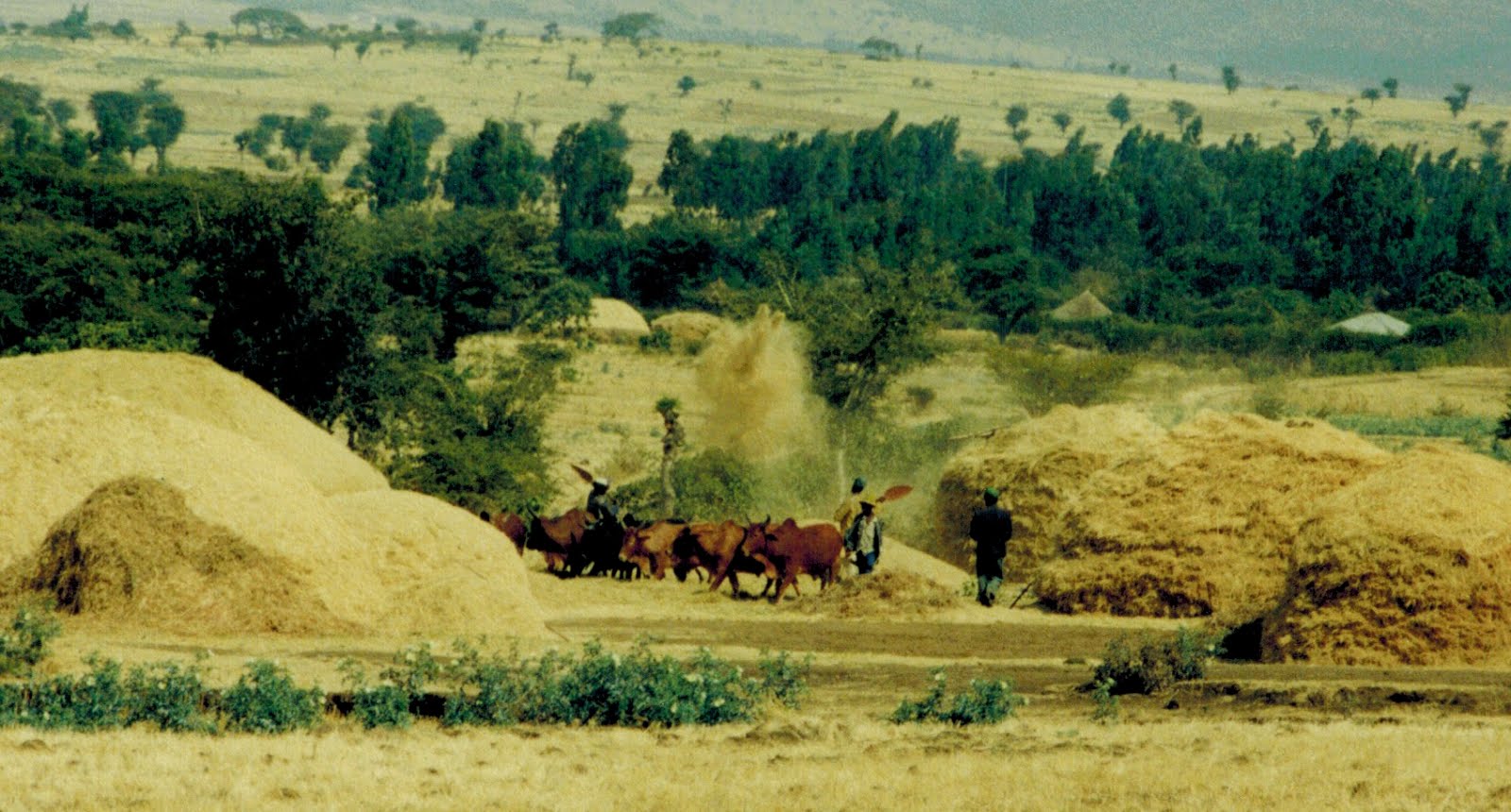
There’s one more thing I wanted to write about the FH/E project in Cheha before I move on to a new topic. I mentioned earlier that veterinary services were part of the program there – the people in that region were known as herders who relied on their cattle both as a food source and for working in the fields. To keep the animals healthy, it was essential to vaccinate them against malaria and trypanosomosis, diseases spread by the tse-tse fly that could weaken cattle, reduce milk production, and eventually lead to death.

These photos weren't taken in Cheha, but they give you a good idea of what the local cattle looked like and how they were used -- in this case, threshing teff to separate the grain from the chaff.


The head of the veterinary service for the Cheha project was Dr. Noda, a Japanese veterinarian – or should I say, The Japanese Veterinarian, because he was a legend. There weren’t a ton of Japanese people in the country so he kind of stood out anyway. And, since he spent most of his time down country, his Amharic was better than his English – which earned him the love and respect of his Ethiopian colleagues. We were in awe.

Friday, February 19, 2016

The Election.


I mentioned a while ago that anyone who knows anything about Ethiopia remembers that there was a serious famine in 1983-85, but like many people our age that was pretty much the only thing we knew about Ethiopia before we agreed to move there for three years. So our first few weeks in the country were a simplified but intensive course in the political and cultural history of Ethiopia in the 20th century.

We had, of course, heard of Haile Selassie, the emperor who ruled the country in one way or another for almost sixty years, from 1916 until he was deposed by revolutionaries in 1974. We didn’t know much about the difficult decades that followed, under the brutal regime of Colonel Mengistu Haile Mariam and the military junta that came to be known as the Derg (Amharic for “Committee”). Mengistu and his cronies in the Derg abolished the imperial government – most Ethiopians believe Mengistu executed the ailing Haile Selassie with his own hands – and established a Marxist-Leninist system that nationalized land and industries, resettled peasants, and aligned Ethiopia with the Soviet Union. In their effort to quell political opposition, the Derg implemented a campaign of intimidation and murder that came to be known as the Red Terror. The campaign lasted for two years, from 1977-1978, and was responsible for the deaths of as many as half a million people, including women and children. A missionary friend of ours remembers driving her kids to school during these years, chatting away in an effort to distract them from the dead bodies that were hanging from lampposts or lying in the streets of Addis Abeba.

Instead of silencing opposing voices, the Red Terror strengthened and consolidated rebellion against the Mengistu regime. Resistance groups throughout the country – Tigray and Eritrea in the north, Oromia in the south – organized insurrections against local Derg strongholds. In 1989 (when we were in college) the Tigrayan People’s Liberation Front (TLPF) joined with the Ethiopian People’s Democratic Movement and other groups to form the Ethiopian People’s Revolutionary Democratic Front (EPRDF). As the EPRDF advanced on Addis Abeba in 1991, the government collapsed. With help from the US government, Mengistu and his family fled to Zimbabwe, where he still lives in luxury under the protection of dictator Robert Mugabe.

By the time we arrived in Ethiopia, the Transitional Government had written a new constitution and had called for a general election to take place – in May 1995. Although Ethiopia’s parliament dates back to Haile Selassie’s 1931 Constitution, this was the first multi-party election in the country’s history. It was kind of a big deal. International observers came from all over the western world, including – it was rumored – former US President Jimmy Carter. There were more than 40,000 polling stations established throughout the country to accommodate nearly twenty million voters. Four of the seven major political parties boycotted the process; as expected, the EPRDF – which had been transformed from a military force into a political coalition – won an overwhelming majority of seats in the House of People’s Representatives. Meles Zenawi, who had dropped out of medical school in 1974 to join the TPLF and had risen to become chairman of the EPRDF, was elected as the first Prime Minister of Ethiopia. (He was re-elected three times, in 2000, 2005, and 2010, and he died in office in 2012. But that’s another story).

As newbies, we didn’t have much of a grasp of the import of the election, and we didn’t know our Ethiopian colleagues well enough to talk about politics back in those days. It had been – and for many it still was – a life-or-death kind of topic in a way that we couldn’t understand. (It became more real to us a few months later, when one of our work colleagues was arrested for his collaboration in the Red Terror. He would have been a teenager at the time. We never heard from him or about him again).

One of my lasting memories about the election is from an early visit to the Cheha site, where I saw a printed handbill pasted up on the wall of a building. I couldn’t read it, but I could see that there were several simple pictures of common household items on it – a jebena (coffee pot), a basket, a spoon. I wish to this day I had taken a picture of it. Curious, I pointed it out to one of the project staff and asked him what it was for. He told me it was a sample ballot designed for areas with limited literacy. Each candidate or political party (I forget which) had been assigned a picture, so if a voter couldn’t read the candidate’s name, he or she could still remember to vote for the coffee pot. Brilliant. These days it’s easy to be cynical about the democratic process, but I will always appreciate how intentional this developing country was about ensuring the right to vote even for its most disadvantaged citizens.

Edit 2/23/2016: Here's a link to an image of the type of ballot I described above. I don't read Amharic well enough to know which election this is from, but you can see the coffee pot, there at number five.

Friday, February 12, 2016

Down Country, Part Three.


You know how sometimes, when you’re watching Antiques Roadshow, there’s a family story that goes along with an object, and more often than not the appraiser has information that undermines or completely contradicts the story? That’s kind of what it has been like for me, comparing my memories of our trip to Cheha with the written account that I sent to my sister at the time, more than twenty years ago.

First of all, it turns out that I went to Cheha not once but twice in the spring of 1995 – the first time with J. and Walter the Kenyan consultant, and a second time with a videographer from FH International (because I was already an expert by then!?). Here’s what I wrote about the first trip:

On Monday and Tuesday (May 8-9) we drove “down country” to FH/E’s Cheha project site. It was a really remarkable experience! We had to remember to take our malaria medication, and we have to continue to remember for the next four weeks. We spent three hours driving 110 km over bumpy, narrow roads, and those were the good roads! But it was well worth it, since we got the chance to hang out with project staff people and to meet and talk with some of the “beneficiaries”. We were really impressed by our visit to a child-to-child group. This is a group of kids who have gotten together to take over what had been an FH demonstration plot, where farmers learned irrigation and agricultural techniques. These 100 kids now come to the plot every day to tend their plants, and when their crops mature they harvest the produce and, after taking some home to their families (and increasing the family’s nutrition) they sell the rest at local markets. These kids know more about gardening than I do! Some of them were also given a goat to raise, and one little boy now has five goats and is relatively wealthy for a ten-year-old. The best part was realizing that these kids are learning things that their parents were never taught about health and nutrition and sanitation, and that gives them something else that their parents have little of – hope for the future. They expect something different out of life.

The second visit – the one I didn’t remember – I read about it in an e-mail message that J. had written to my sister in early June, telling her how much he missed me while I was away. We may still have a copy of the videotape that was made during this trip, in which case I will see if I can digitize the Ethiopia bits and get them online.

So: malaria. It turns out that the Anopheles mosquito, the one that hosts the malaria parasites, doesn’t live at high elevations. In Addis Abeba we were over 7500 feet, which is high by any standard, and this was both a drawback and a benefit for us. For example, water boils at about 198 degrees at that elevation, which means we had to boil our drinking water for several minutes to sterilize it. Baking was always a challenge, and not just because we were working with a finicky gas oven. Whenever we left town we ran the risk of developing a nasty altitude headache when we got back home. BUT – unlike most of our colleagues who worked in Africa – we did not have to take anti-malarial medication on the regular, and that more than made up for any inconveniences.

Our anti-malarial arsenal at the time included two drugs, chloroquine and mefloquine. According to Wikipedia, when chloroquine was first discovered in the 1930s, it was ignored for a decade because it was considered too toxic for human use. Potential side effects include muscle damage, loss of appetite, diarrhea, skin rash, problems with vision, and seizures. The common side effects of mefloquine, which was only approved for prophylactic use in 1989 (!!!), include vomiting, diarrhea, headaches, and a rash – but it also has potentially long term neurological side effects including seizures and mental illness. We knew none of this. We were encouraged to use the drugs in combination when we left the capital to make sure were we protected against different strains of malaria.

Our Ethiopian colleagues were just as vulnerable to malaria as we were, but they used different prophylactic tactics. The most common of these was an aerosol pesticide spray – Mobil brand, like the gas station – that they deployed liberally before they went to bed. My memories of those first visits to Cheha include sleeping (or trying to sleep) in a hot, airless, pitch-black room in a cinder block building, breathing in the petro-floral scent of Mobil spray. Waking up in that room was like waking in a tomb, dark and disorienting. There was no electricity, of course, and we had to keep the window shutter closed because there was no glass or screen or net to keep the mosquitoes away while we slept; after all, the very best way to prevent malaria is not to be bitten. And we didn’t get malaria; at least, not on that trip. That, I would have remembered!